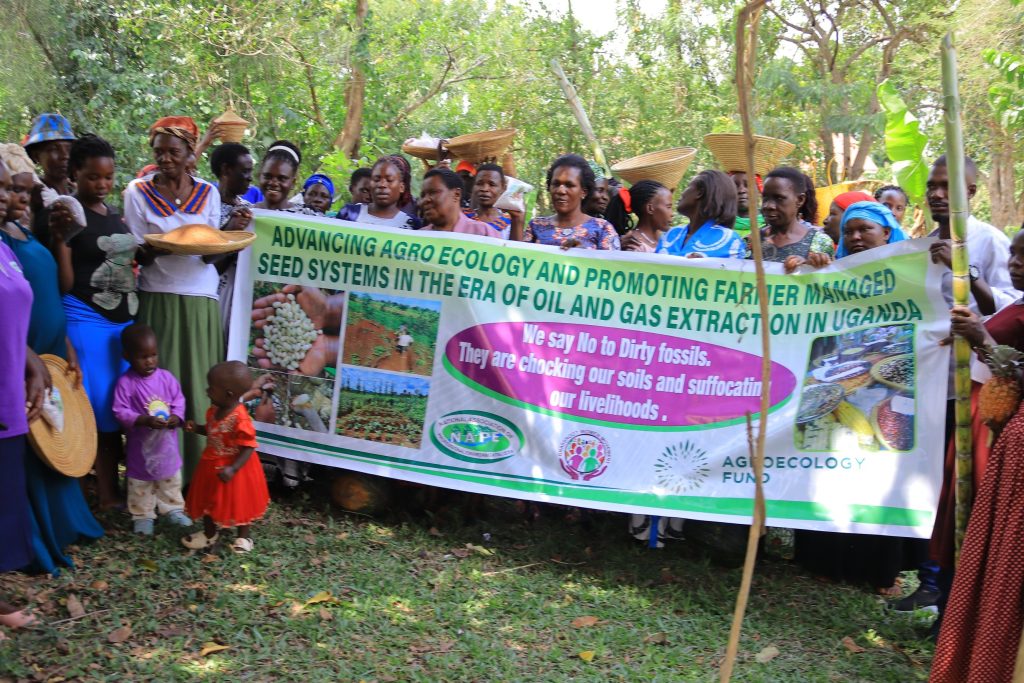
Agro ecology farmers call for a halt of dirty fossils in their localities during an intergenerational field learning mission July 2026.
Compiled by Polycarp Omony NAPE/CGR
“OUR LAND, OUR FUTURE”
Grass root women organized under the grass root women led movement coordinated by National Association of Professional Environmentalists (NAPE) have continued to show dissatisfaction with the ongoing oil and gas development Agenda in their localities. This was during an intergenerational field learning and knowledge exchange mission organized in the Oil rich district of hoima, kyabigambire parish, kasomoro village by NAPE and partner local groups with support from the Agroecology Fund for East Africa.
Women are finding it hard to earn living amidst a long dry spell, diminished farmer yields and disappearance of indigenous seeds and introducing of exotic seed species that according to them is blamed on an ever expanding extractive sector industry punctuated by massive land grabs and corporate induced displacements since early 2000s when active oil and gas extraction began in Uganda’s most fragile Albertine rift a region highly vulnerable to disturbance.
Uganda has had massive oil and gas investment agendas since 2004 and has established multiple oil and gas investments including the Hoima International Airport, Oil waste consolidation sites, oil worker labour camps, crude oil processing facilities in Buliisa distrct Kasinyi village ,Gwedo sub county and at Kingfisher oil field in Kikuube distrct, Kyagwali sub county, hundreds of kiolmetres of Oil and gas roads and feeder pipelines, more than 180 drilled oil and gas wells, and currently the longest heated oil and gas pipeline (EACOP) a 1,443 km long pipeline is under way . These for the past years have caused massive social, economic, cultural and ecological disasters.
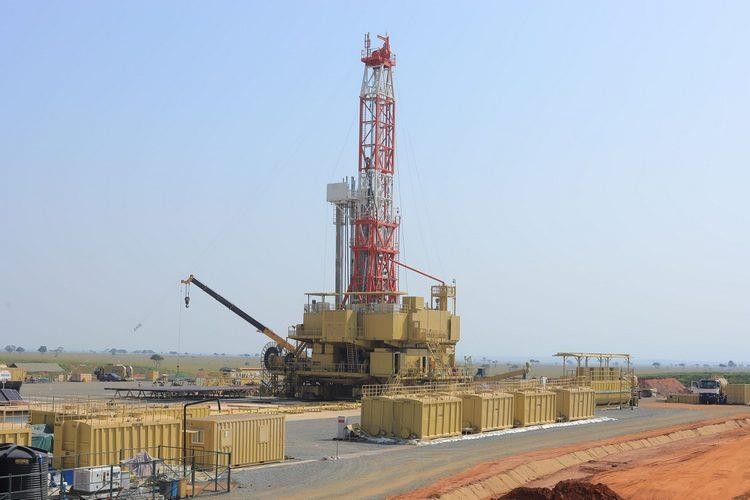
Drilling operations progress at key multiple fields, that include Kingfisher, Jobi Rii, Ngiri, Kasamene-Wahrindi, Gunya, Nsoga, and Kigogole in Murchison, Kabwoya and Bugungu Wildlife Reserves.
Recognized as Africa’s most bio-diverse hot spot, the Albertine rift is a home to 39% of Africa’s mammals species, 51% of African Bird species, 19% of African amphibian species, 14% of Africa’s Plants and reptile species and 79 threatened terrestrial vertebrates according to IUCN red data book listings. The rift further hosts 60% of Uganda’s water bodies (lakes and rivers), 70% of Uganda’s protected areas with 7 out of the 10 National Parks in Uganda, 8 out of 15 forests, 12 Wildlife Reserves, 13 Wild Life Sanctuaries, and 5 Community Wild Life Areas. The region hosts close to 20% of Uganda’s total population majority driving their livelihoods from crop farming, animal rearing, fishing and hunting.
The introduction of oil has massively diminished livelihoods and left many indigenous household farmer communities in a state of landlessness, food insecure, displaced and it’s on this basis that NAPE is closely working with landscape based groups such as Kyabigambire women farmers group –Kamu-Kamu, Kwataniza Women farmers group, Butimba Sustainability Conservation Association, Kakindo Women Integrated Development Association, Kaiso Womens group among others.
With support from the East Africa Agro Ecology fund (EAAEF) to revive and nurture “An agro ecology community of Practice” and build a strong grass root women led movement of agro ecology farmers that are seed and food sovereign collectively organizing and pushing back against the dangers of extractives and promoting community food sovereignty through reviving farmer managed seed systems based on indigenous knowledge that is affordable, readily available and adaptable to all areas.
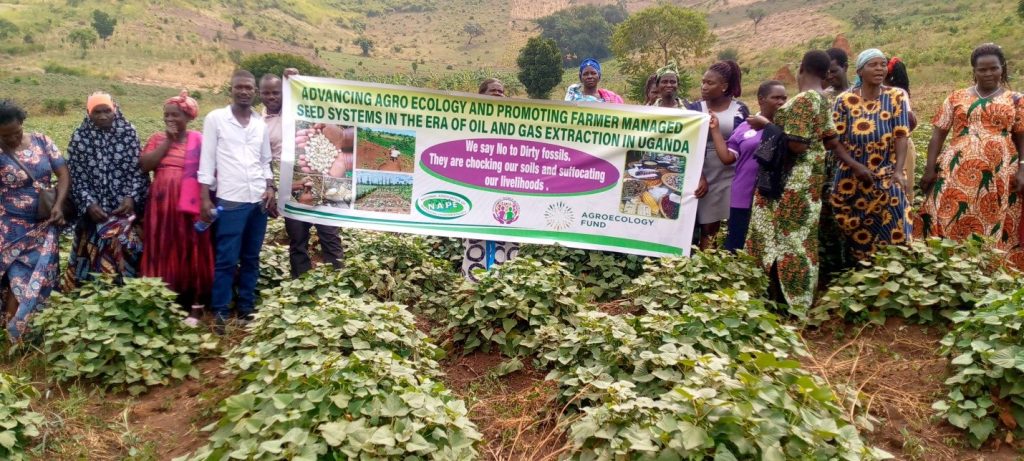
Agro ecology farmers supported by NAPE say no to dirty fossils during a field learning mission on their agro ecology mother garden of indigenous seed species-July 2026
Oil and gas extraction in Uganda compounds a series of unexplained social cultural, economic, ecological challenges;
- Massive land grabs and involuntary displacement of more than 100,000 indigenous farmers along oil pipeline, oil roads and oil drilling well sites.
- The oil in Uganda is the poor quality solid waxy oil that will need to be heated permanently to 50°C to keep it fluid and transport it to the port of Tanga, in Tanzania, and into international shipping tankers which brings serious risks of dirty emissions, climate change and accidents.
- This pipeline would transport 200,000 barrels of oil per day and generate up to 34 million tons of carbon emissions each year – seven times what Uganda currently emits each year and about 1/16th of France’s emissions a factor that poses serious consequences to global warning.
- Oil projects risk poisoning the water resources and wetlands of Uganda and Tanzania, including the Lake Victoria Basin, on which more than 40 million people depend for drinking water, food production and their livelihoods.
- The project already continues to violate a multitude of human rights: the right to property, the right to an adequate standard of living, the right to food, the right to education, the right to health, the right to adequate housing, the right to life and safety, the right to freedom of expression, assembly and association, and the right to free, prior and informed consent as communities are forced out of their land to give way for oil and gas infrastructure majority signing documents in darkness that they do not understand.
- The EACOP is set to affect 158 wetland sections in Uganda. The pipeline will cross wetlands in all the ten districts that it will pass in Uganda and many more in the 5 regions of Tanzania.
- It will affect over 17 wetlands draining into Lake Victoria, 8 wetlands draining into the Victoria Nile and 4 wetlands draining into the Lake Albert basin.
- Of concern is the fact that the EACOP is set to affect the Kibale/Bukoora wetland system, which begins in Western Uganda and connects to Kyotera as well as Rakai district in south Uganda.
- The Kibaale/Bukoora wetland is the most important in the Sango Bay-Musamba Island-Kagera (SAMUKA) Wetland System, a Ramsar site. SAMUKA has immense biodiversity conservation importance and an economic value of USD 117 million per year (Sango Bay only).
- Additionally, the EACOP is set to affect the Katonga wetland system, which is one of the key systems in the Lake Victoria basin. Katonga is also connected to the Nabajjuzi Ramsar Wetland. Up to 40 million people in East Africa rely on Lake Victoria to meet their water and other needs.
- The EACOP is set to affect Nabakazi wetland ecosystem in Greater Mubende district and crosses the wetland 3 times over a distance of 64 kms. The wetland is of socio-cultural importance to the Baganda of central Uganda as it is home to totems such as the Sitatunga (Njobe) and the barkcloth tree.
- Nabakazi wetland also has peat soils. Peat is reported to store more carbon than any vegetation type and is important for climate stabilisation.
Further, The East African Crude Oil pipeline (EACOP) project violates multiple legal regimes of national, regional and international nature outlined below;
- The Ugandan constitution Article 26 that gives land owners exclusive rights over their land until they are adequately compensated or resettled,
- The spirit and letter of Articles 5 (3) (c), 8(1) (c), 111 (1) (b) & (d), 111 (1) & (2), and 114 (1) of the Treaty for the Establishment of The East African Community (EAC) on the protection of the environment.
- Protocol for Sustainable Development of Lake Victoria 1999: – Articles 4,5,12, 13 and 14 which provide for a regional requirement developed by Kenya, Tanzania, and Uganda to fairly and effectively manage the resources of Lake Victoria.
- World Heritage and Ramsar sites violations: For instance, EACOP’s proposed route will negatively impact a number of protected areas, including the Ngorongoro National Park, a World Heritage site, as well as the Murchison Falls-Albert Delta Wetland System, a designated Ramsar site
- Violating the Paris Agreement of 2015 -which China, Tanzania, and Uganda and France are all signatories as a legally binding treaty to combat climate change by limiting global warming below 2 2°C—ideally 1.5°C above pre- industrial levels.
- Violating the free, prior, informed consent rights and best practices of Indigenous and affected communities along the EACOP right of way.
- EACOP violates the 2017 French Duty of vigilance law (devoir de vigilance) that mandates Large French companies to identify and prevent risks to human rights, fundamental freedoms, healthy, safety and the environment through their operations, subsidiaries and supply chains.
- Violating International Human Rights standards –as per the 2022 European Parliament Resolution (P9 TA (2022)0321 hence contradicting EU commitment to Human Rights.
- Violating Chinese guidelines for Green Development in Overseas Investment and Cooperation which obligate Chinese companies to “to conduct environmental assessments and due diligence for a proposed project in accordance with international practices to identify potential environmental risks” as well as “push for prevention of ecological risks”.
- Violating Chinese guidelines for Ecological Environmental Protection in Foreign Investment Cooperation and Construction Projects which obligates Chinese entities to conduct biodiversity surveys, and if high biodiversity risks are identified, the company must justify its decision for the project site and consider alternative locations (Article 6).
- EACOP further Violets China’s List of Sensitive Sectors for Overseas Investment, published in 2018 by China’s National Development and Reform Commission by affecting Lake Victoria and likely breeding potential for water use and management related conflicts between Uganda, Tanzania, Kenya and Democratic Republic of Congo over usage of Trans boundary water bodies of Victoria and L.Albert
- And lastly due to the violation of local laws and international norms above, any Chinese bank involved in EACOP likely is violating key Chinese bank regulatory policies, such as the 2012 Green Credit Guidelines, 2014 Key Performance Indicators on Green Credit and the new 2022 Green Finance Guidelines.