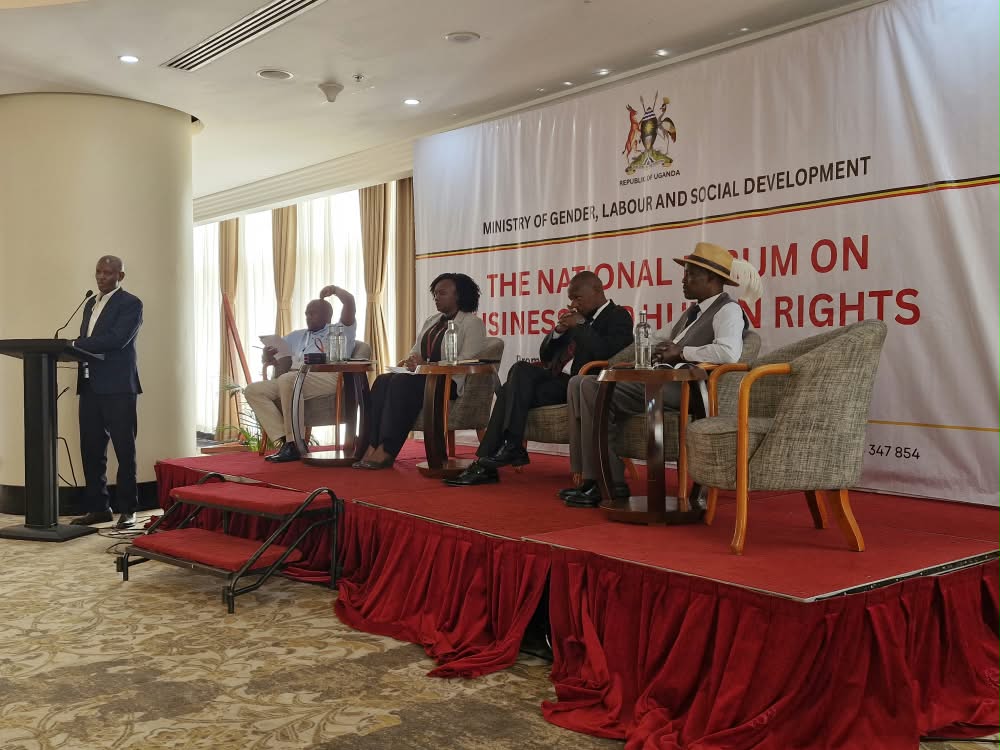
As Uganda continues to pursue economic growth through investments in sectors such as oil, gas and mining, questions of corporate accountability, environmental protection and the rights of affected communities remain critical. NAPE attended Uganda’s 7th Annual National Forum on Business and Human Rights that brought together government representatives, private-sector actors, civil society organisations, development partners, legal practitioners and other stakeholders to reflect on the country’s progress in promoting responsible business conduct and protecting human rights held at Sheraton Hotel in Kampala, the forum was organised under the theme “Reflecting on Progress and Strengthening Commitment: The Journey of Uganda’s National Action Plan on Business and Human Rights.”
The forum provided an important platform for assessing the implementation of Uganda’s first National Action Plan on Business and Human Rights (2021–2026), identifying persistent gaps and discussing priorities for the next phase. The discussions highlighted the need to ensure that economic development, investment and industrial growth go hand in hand with respect for human rights, environmental protection, workers’ welfare and community interests.
A central message emerging from the discussions was that the success of business and human rights initiatives should not be measured merely by the existence of laws, policies and corporate commitments, but by the extent to which these commitments translate into tangible improvements in people’s lives. One of the significant contributions to the forum was the keynote address by Professor Christopher Mbazira of Makerere University, who reflected on the development of the business and human rights agenda and the challenges Uganda must address to strengthen corporate accountability.
The United Nations Guiding Principles on Business and Human Rights provide a framework built around three pillars: the state duty to protect human rights, the corporate responsibility to respect human rights, and access to effective remedy for people whose rights have been violated. The keynote discussion placed the importance of these principles within Uganda’s continuing efforts to improve responsible business conduct.
Business enterprises must be assessed not only by the economic opportunities they create, but also by their impact on workers, communities and the environment. Unsafe working conditions, displacement, corruption and other forms of corporate misconduct demonstrate why accountability must remain central to the relationship between business and society.
A major takeaway was the need to strengthen Uganda’s legal and institutional framework for responsible business conduct. Although the country has laws addressing employment and environmental protection, gaps may remain in areas such as labour protection, supply-chain governance and social impact assessment. Weak enforcement and inadequate monitoring can leave workers and communities exposed to human rights abuses even where relevant laws exist.
The discussion also underscored the importance of adequate financing, reliable data and effective coordination among institutions responsible for implementing the National Action Plan. Without accurate information on business-related harm, government and other stakeholders cannot adequately assess progress or determine whether interventions are improving the situation of affected people.
Looking ahead, the next National Action Plan should include measurable targets, clear timelines, designated lead institutions and practical mechanisms for providing remedies. The central lesson is that good policies are only the beginning; meaningful progress requires enforcement, resources, reliable evidence and accountability for results.
An important highlight of the forum was Panel 15, organised by Civic Response on Environment and Development (CRED) under the theme “Climate Change, Environmental Justice, and Corporate Responsibility in Uganda’s Extractives Sector.” The session was moderated by Mr. Baryamujura Mahad of CRED and brought together Ms. Gertrude Angom of the Extractive Industries Transparency Initiative (EITI), Mr. Robert Turyakira of the African Green Health Network (AGHNET), and Ms. Komuntale Immaculate, a human rights defender.
The panel addressed a critical question for Uganda’s development: how can the country benefit from investment in extractive industries while protecting the environment, respecting community rights and ensuring that the costs of development are not disproportionately borne by vulnerable populations? The discussion was relevant given the expansion of oil, gas and mining activities and the potential implications for land, forests, wetlands, water resources, and biodiversity and community livelihoods.
CRED’s session reinforced the principle that corporate responsibility must extend beyond philanthropy and compensation. Responsible businesses must anticipate environmental and human rights risks, prevent avoidable harm, disclose relevant information, engage affected communities meaningfully and provide effective remedies when violations occur.
Hon. Norbert Mao (Minister of Justice and Constitutional Affairs of Uganda) called upon all stakeholders to work collaboratively in promoting accountability, fairness, safety and respect for the rule of law in business and human rights. He emphasized that protecting human rights requires collective responsibility among government institutions, private companies, civil society organisations and affected communities. Stakeholders must be willing to account for their decisions and actions, ensure that business operations are conducted fairly and safely, and take proactive measures to prevent human rights abuses. He further stressed the importance of responding promptly whenever grievances arise, ensuring that complaints are taken seriously, investigated impartially and addressed through appropriate mechanisms. Where abuses occur, those affected must have access to effective redress, including remedies that address the harm suffered and help prevent similar violations in the future. Above all, he underscored that respect for the rule of law must remain central to business operations and public decision-making, with all actors complying with applicable laws and being held accountable for violations. His message reinforced the need to move beyond commitments on paper towards practical action that safeguards human dignity strengthens public trust and promotes responsible business conduct in Uganda.
Key lessons from the entire forum
- The next National Action Plan is an opportunity to strengthen implementation. The next phase should establish measurable commitments, clear institutional responsibilities, realistic timelines, dedicated resources and public reporting mechanisms to track progress.
- Responsible business conduct requires demonstrable accountability. Corporate social responsibility initiatives may support communities, but they cannot substitute for the obligation to respect human rights, comply with applicable laws and prevent environmental harm.
- The implementation gap remains a major challenge. Uganda has a National Action Plan and relevant legal frameworks, but their effectiveness depends on adequate financing, institutional capacity, coordination, monitoring and enforcement.
- Meaningful community participation must be central to development decisions. Communities should be involved before decisions are finalised and throughout project implementation. Participation should enable affected people to influence decisions rather than simply receive information after important choices have been made.
- Access to information is fundamental to accountability. Workers and communities need reliable information about business operations, environmental risks, labour conditions and available complaint mechanisms.
- Access to remedy must be strengthened. People affected by corporate misconduct need accessible and effective avenues for seeking justice, including responsive institutions, functioning grievance mechanisms, legal assistance and protection for those who report abuses.
What this means for NAPE and environmental advocacy
For the National Association of Professional Environmentalists (NAPE), the forum reinforced the importance of integrating environmental protection, human rights and corporate accountability in development processes. NAPE’s work on environmental governance, community participation, ecosystem protection and environmental legal advocacy provides a basis for contributing to the national business and human rights agenda.
Environmental challenges associated with land acquisition, deforestation, wetland degradation, pollution and extractive activities cannot be addressed effectively without considering the rights and interests of affected communities. NAPE can contribute by documenting environmental and human rights concerns, strengthening community awareness, promoting access to environmental information, engaging duty bearers and advocating for effective enforcement of environmental laws. Public-interest litigation and other accountability mechanisms can also play an important role in addressing violations.
The forum further demonstrated the importance of ensuring that women, Indigenous Peoples, young people and other marginalised groups are meaningfully involved in environmental decision-making. For NAPE, an important takeaway is that environmental protection must move beyond conservation activities alone to address governance, accountability, human rights and the ability of communities to influence decisions that affect their lives.
As Uganda advances its business and human rights agenda beyond the 2021–2026 National Action Plan, the priority should be to translate commitments into measurable improvements in the lives of workers and communities. Ultimately, the success of responsible business conduct should be judged not only by the wealth businesses generate, but also by whether human rights are respected, ecosystems are protected, communities benefit fairly and people harmed by business activities can obtain justice.