
By Ainomugisha Shiba
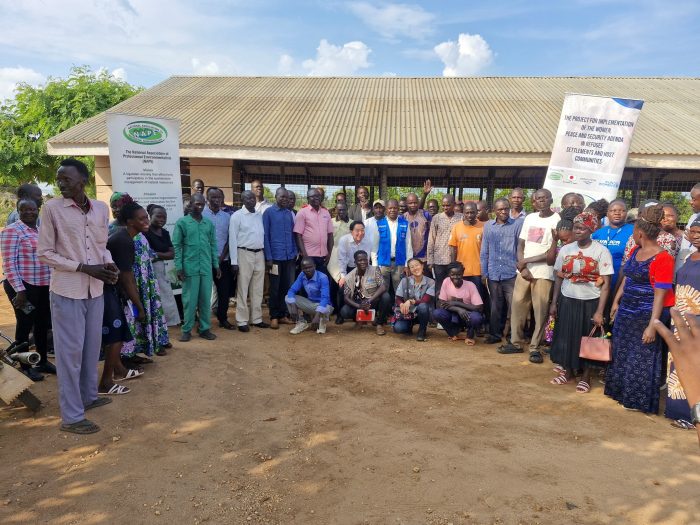
Climate change, environmental degradation, and displacement continue to pose significant challenges to both refugee and host communities in Uganda. These challenges have increased competition over natural resources, heightened the risk of disasters such as floods and droughts, and contributed to conflicts that disproportionately affect women and young people. Although women are among the most affected by climate-related shocks, they often remain underrepresented in decision-making processes concerning climate action, peacebuilding, and disaster preparedness. Recognizing this gap, the National Association of Professional Environmentalists (NAPE) is implementing the project titled “Implementation of Women, Peace and Security Agenda in Host Communities and Refugee Settlements in Uganda” to empower women and youth as key actors in building resilient and peaceful communities.
The project is being implemented with funds from The People of Japan in partnership with UN Women and Peace Winds Japan across two refugee-hosting regions of Uganda West Nile and Southwestern Uganda. The intervention covers five districts: Adjumani (Ayilo I Refugee Settlement), Yumbe (Bidi Bidi Refugee Settlement), Madi Okollo (Rhino Camp Refugee Settlement), Isingiro (Nakivale Refugee Settlement), and Kyegegwa (Kyaka II Refugee Settlement). These areas host large refugee populations and continue to experience the combined effects of climate change, environmental degradation, and increasing pressure on natural resources. Such challenges often create tensions between refugee and host communities, making integrated approaches to peacebuilding and climate resilience essential.
Under this project, NAPE is responsible for implementing Outcome 3, which aims to ensure that 3,100 women and youth have increased participation in and benefit from gender-responsive climate change mitigation and Disaster Risk Reduction (DRR) systems and programmes to overcome conflict and climate shocks. This work contributes directly to UN Women Strategic Note Outcome 2.2, which seeks to strengthen women’s leadership and participation in promoting peace, security, resilience, and sustainable development.
NAPE’s approach recognizes that climate change is more than an environmental issue; it is also a social and peacebuilding challenge. Increasingly unpredictable weather patterns, prolonged droughts, floods, and environmental degradation threaten livelihoods and intensify competition over scarce resources such as land, water, forests, and grazing areas. In refugee-hosting communities, these pressures can fuel tensions between refugees and host populations if not effectively managed. By integrating climate action with peacebuilding and gender equality, the project seeks to address the root causes of vulnerability while strengthening community resilience.
To achieve this, NAPE works closely with local governments, the Office of the Prime Minister, refugee welfare councils, community leaders, women’s organizations, youth groups, and other stakeholders to strengthen local capacity in climate adaptation and disaster preparedness. Through a series of trainings, community dialogues, awareness campaigns, and practical demonstrations, women and young people acquire knowledge and skills in disaster risk reduction, climate change adaptation and mitigation, early warning systems, environmental conservation, and conflict-sensitive natural resource management. These interventions enable communities to prepare for climate-related emergencies while reducing risks before disasters occur.
A key aspect of the project is promoting women’s meaningful participation in community leadership and decision-making. Women possess valuable indigenous knowledge and practical experience in managing natural resources and responding to crises, yet they are often excluded from formal governance structures. NAPE is working to change this by creating opportunities for women and youth to participate in local disaster management committees, climate governance platforms, peacebuilding initiatives, and community development processes. Their increased participation ensures that disaster response and climate adaptation strategies are inclusive, responsive to community needs, and sustainable over the long term.
The project also promotes environmental stewardship as a pathway to peace. Refugee and host communities are encouraged to work together in activities such as tree planting, ecosystem restoration, sustainable land management, and environmental awareness campaigns. These joint initiatives not only improve the natural environment but also strengthen trust, cooperation, and peaceful coexistence among communities that depend on shared natural resources. By addressing environmental challenges collectively, communities reduce the likelihood of resource-based conflicts while building resilience to future climate shocks.
Through this intervention, NAPE is contributing to the broader implementation of the Women, Peace and Security Agenda by demonstrating that empowering women and youth is fundamental to achieving sustainable peace and climate resilience. The project’s target of reaching 3,100 women and youth across Ayilo I, Bidi Bidi, Rhino Camp, Nakivale, and Kyaka II refugee settlements represents an important investment in community leadership, environmental sustainability, and inclusive development.
As climate change continues to affect vulnerable populations across Uganda, strengthening the capacity of women and youth to lead disaster risk reduction and climate adaptation efforts has never been more important. Through this project, NAPE is helping to build communities that are better prepared to prevent conflicts, respond to climate-related disasters, protect natural resources, and promote peaceful coexistence. By placing women and young people at the centre of resilience-building, the organization is contributing to a future where refugee and host communities can thrive together despite the growing challenges posed by climate change.